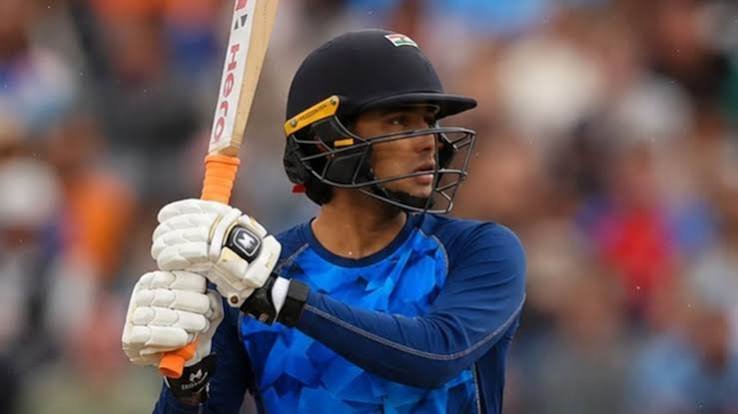

The Indian opener’s double century helped Amritsar reach 533 for eight from 50 overs before Tarn Taran finished on 313 for eight. The resulting 220-run victory was built around Sharma’s batting, although his contribution continued later with two wickets through his left-arm spin.
Boundary Hitting on an Exceptional Scale
Sharma scored 210 of his 233 runs in boundaries, collecting 150 through sixes and another 60 from fours. Only 23 runs came through running between the wickets, illustrating how consistently he was able to clear or penetrate the field.
The innings was not simply a short burst at the end of the contest. Opening the batting, Sharma sustained his scoring rate long enough to influence almost half of Amritsar’s total. Tarn Taran’s bowlers were given little opportunity to control the innings once he established his attacking rhythm.
A 305-Run Partnership Sets Up Amritsar
Sharma shared a 305-run opening partnership with Abhay Choudhary, who contributed 93 from 85 deliveries. Choudhary’s more measured innings provided balance while Sharma continued attacking from the opposite end.
That partnership established the platform for Amritsar’s middle order to maintain the pressure. Abhinav Sharma added 51, while Sahil Sharma scored 37 and Sumit Sharma finished with 23 not out as the team moved beyond 500.
A total of 533 for eight left Tarn Taran requiring more than ten runs per over from the beginning of its chase. It was a target that demanded sustained aggression without leaving any margin for a prolonged quiet period.
Abhishek Contributes with the Ball
Tarn Taran responded with 313 for eight from its 50 overs. Arsh Deep Singh scored 108 and Manpreet Singh Sandhu made 62, but their efforts could not seriously threaten Amritsar’s imposing total.
Sharma completed his all-round performance by taking two wickets for 71 runs from nine overs. His left-arm spin accounted for Karanveer Singh Dhillon and centurion Arsh Deep, while Prathampal Singh Walia led Amritsar’s bowling effort with four for 49.
The bowling contribution added context to the performance. Sharma remains most valuable when his batting can be supported by useful overs, particularly in white-ball matches where team balance influences selection.
A Response After a Difficult International Run
The double century arrived after a challenging period in international cricket. Sharma had collected only 40 runs across his previous six T20I innings and registered scores of 2, 8 and 1 during India’s tour of Zimbabwe.
An inter-district attack cannot be compared directly with international bowling. The pace, tactical planning and pressure are different. However, a long and dominant innings can still help a batter restore timing, decision-making and confidence before returning to a higher competitive level.
Sharma’s approach has always involved calculated risk during the powerplay. The challenge is maintaining that intent without allowing bowlers to exploit predictable scoring areas. His innings for Amritsar demonstrated the damage he can cause when length and contact remain under control.
What the Innings Means for India
Sharma is already an established member of India’s T20I plans rather than an emerging player seeking his first opportunity. As a result, one domestic innings is unlikely to decide his position. International selection will continue to depend on repeated performances against elite attacks.
Even so, the scale of this innings makes it significant. Scoring 233 from 91 balls requires concentration as well as power, especially after passing the landmarks where batters often lose rhythm. It also reinforces the value of Sharma continuing to play competitive cricket between international assignments.
India’s top-order options are judged on more than strike rate. Adaptability against high pace, disciplined short bowling and spin during the middle overs will remain important. Sharma’s next objective is to carry the confidence from Amritsar into those more demanding situations.
Final Assessment
Abhishek Sharma’s 233 was a forceful response to questions surrounding his recent form. His 25 sixes and 15 fours powered Amritsar to 533 for eight, while two wickets completed an influential all-round performance in a 220-run victory.
The innings should not be treated as automatic proof that every international concern has been resolved. It does, however, confirm that Sharma’s timing, confidence and boundary-hitting remain capable of overwhelming an opposition. The more important test will be reproducing that clarity when the standard of bowling rises.
Frequently Asked Questions
How many runs did Abhishek Sharma score?
Sharma scored 233 from 91 balls for Amritsar Men Senior against Tarn Taran Men Senior.
How many boundaries did he hit?
His innings included 15 fours and 25 sixes. Those boundaries contributed 210 of his 233 runs.
What was Abhishek Sharma’s strike rate?
He finished with a strike rate of 256.04.
What total did Amritsar score?
Amritsar reached 533 for eight from its allotted 50 overs before defeating Tarn Taran by 220 runs.
Did Abhishek Sharma take any wickets?
Yes. He took two wickets for 71 runs from nine overs with his left-arm spin.
Add Comment