
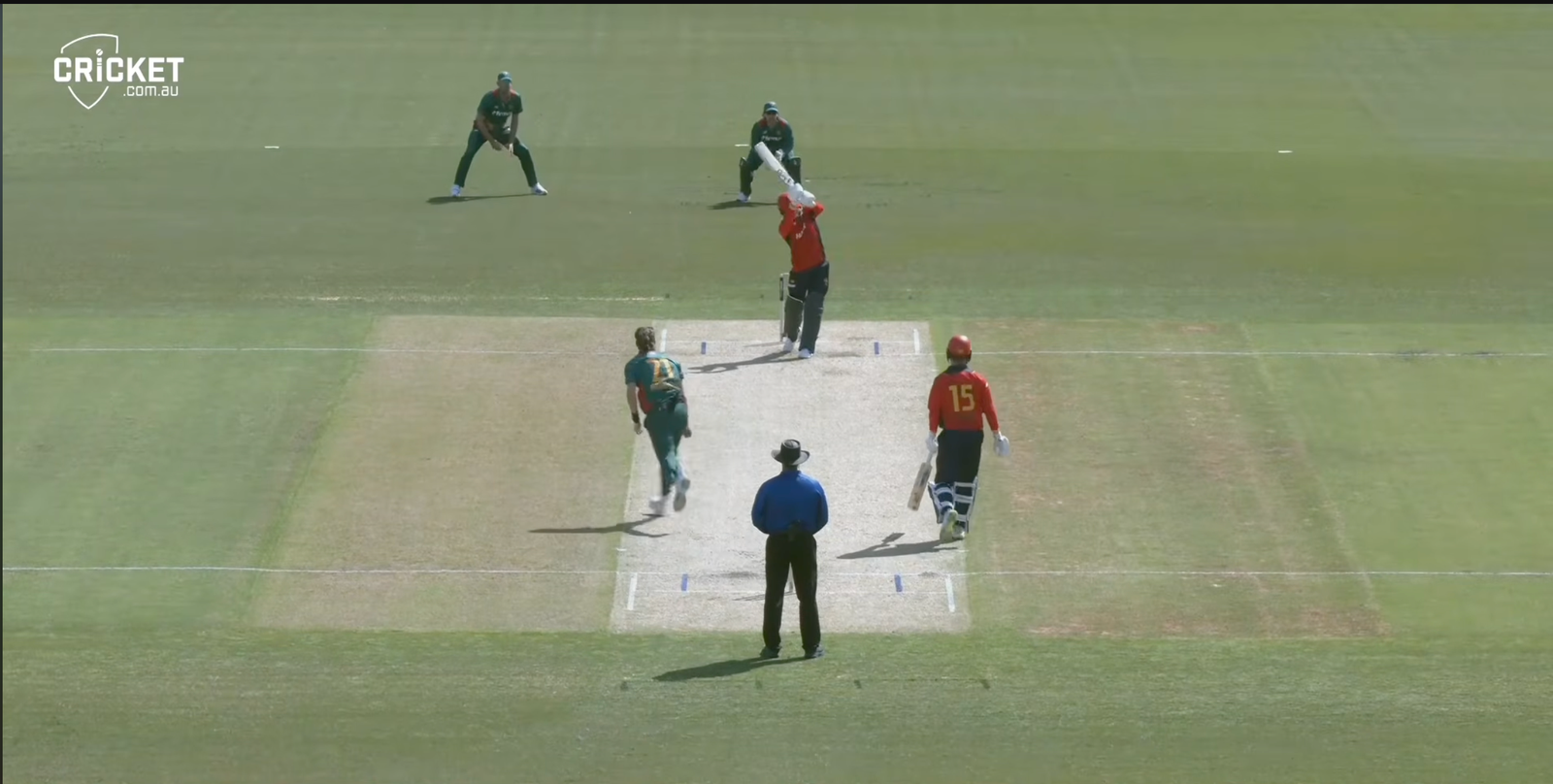
88 runs. 47 balls. 9 fours. 6 sixes.
The numbers themselves are enough to tell the story. But the interesting part is the manner in which those runs came. There was very little evidence of a batter trying to settle himself before taking the attack apart. Instead, the intent was visible almost immediately. Anything in his hitting zone was treated accordingly.
And six sixes in 47 deliveries is no ordinary contribution in a 50-over competition.
This is probably the most fascinating aspect of Fraser-McGurk's batting. The format may demand patience at certain stages, but his natural game does not seem interested in waiting too long. He wants to dictate terms. Of course, that comes with its own risks, but when it comes off, the opposition can find themselves behind the game before they have properly settled.
Fraser-McGurk eventually departed for 88, but South Australia had already received what they needed from their opener. Jake Weatherald then carried the innings forward with 92, before Matthew Gilkes added the finishing touch with an unbeaten 97 from 65 balls.
Accordingly, South Australia finished with 383/7.
On most occasions, a total of 383 in a One-Day Cup match would put the chasing side under enormous pressure. But Tasmania were not prepared to simply accept the situation.
Mitch Owen provided the early impetus before Jordan Silk took over. And this is where the contest became far more interesting than the scorecard might initially suggest.
Silk was magnificent.
The Tasmanian batter produced 142 from 106 balls and kept the chase alive for far longer than South Australia would have wanted. The required rate kept moving upwards, but Silk continued to find ways of bringing the equation back under control. With him still at the crease, the possibility of a remarkable chase was always there.
That is probably what made Fraser-McGurk's innings even more important.
South Australia had not merely scored quickly at the beginning. They had created a cushion. Tasmania came remarkably close to making that cushion irrelevant, but eventually Silk's dismissal proved to be the decisive moment.
Tasmania ended on 376/8.
Seven runs.
That was the difference between the two sides.
For Fraser-McGurk, though, the headline belongs to those 47 deliveries. He did not score the highest number of runs in the match. He did not even bat through the innings. But he gave South Australia exactly the kind of start that allows a 383-run total to become possible.
And that is what makes players like him so valuable in modern one-day cricket.
The ability to score quickly is one thing. The ability to make an innings feel as though it belongs to a different format is another. Fraser-McGurk managed to do the latter. Six balls went over the boundary, nine found it along the ground or through the field, and suddenly 47 deliveries were enough to change the complexion of the match.
The One-Day Cup is still a 50-over competition. The requirement to build an innings has not disappeared. But perhaps the definition of building an innings is changing too.
Sometimes, it does not mean batting for 100 balls.
Sometimes, 47 are enough.
Add Comment